
Structural Design of Rubber Tire Crane Chassis
The chassis is the fundamental load-bearing and motion-supporting structure of a rubber tire crane. Whether applied in rubber-tyred gantry cranes (RTGs), mobile gantry cranes, or rubber-tyred lifting systems for precast yards and industrial material handling, the chassis directly determines the crane’s stability, durability, travel performance, and safety margin. A well-engineered chassis must not only carry the full rated load and self-weight of the crane but also absorb dynamic forces generated during lifting, traveling, braking, and turning operations.
In modern lifting equipment design, the rubber tire crane chassis is no longer a simple steel frame. It is a highly optimized structural system integrating load distribution, torsional resistance, fatigue strength, suspension compatibility, and adaptability to complex ground conditions. This article provides a comprehensive overview of the structural design principles, key components, load analysis methods, and engineering considerations involved in rubber tire crane chassis design.
Role of the Chassis in Rubber Tire Crane Systems
The chassis serves as the primary structural foundation of the crane. It connects the vertical load-bearing structures, such as legs or portal frames, to the running gear, including wheels, axles, suspension elements, and drive systems. All operational forces ultimately transfer through the chassis to the ground via the rubber tires.
In rubber tire cranes, the chassis must fulfill several critical roles simultaneously. It supports static loads from the crane structure and lifted cargo, resists dynamic loads during motion, maintains geometric stability under uneven ground conditions, and provides mounting interfaces for mechanical, hydraulic, and electrical systems. Unlike rail-mounted cranes, rubber-tyred cranes rely entirely on chassis stiffness and tire compliance to maintain stability and alignment.
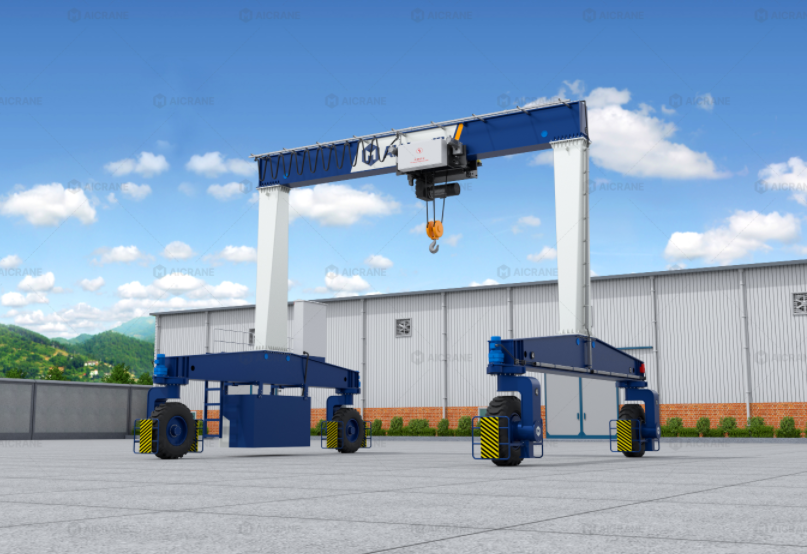
Basic Structural Configuration of Rubber Tire Crane Chassis
Most rubber tire crane chassis adopt a box-type or frame-type welded steel structure. The configuration varies depending on crane capacity, span, wheel arrangement, and application environment.
Main Frame Structure
The main frame is typically composed of longitudinal beams and transverse beams welded into a rigid framework. High-strength structural steel plates are used to form closed or semi-closed box sections, which significantly improve bending resistance and torsional stiffness. The frame geometry is carefully designed to distribute loads evenly across all wheels while minimizing localized stress concentrations.
For medium and heavy-duty rubber-tyred cranes, the main frame often features reinforced beam intersections, diaphragms, and stiffeners to prevent deformation under high loads. These reinforcements are especially critical at wheel mounting zones and leg connection points.
Wheel and Axle Support Zones
Wheel support zones are among the most highly stressed areas of the chassis. The structural design must account for vertical wheel loads, lateral forces during steering, and longitudinal forces during acceleration and braking. Reinforced bearing plates, gussets, and thickened steel sections are commonly used to ensure long-term structural integrity.
Depending on the crane type, the chassis may support multiple wheel sets arranged in two, four, or eight-wheel configurations. Equal load sharing across all wheels is a key design objective to prevent uneven tire wear and excessive ground pressure.
Load Analysis and Structural Design Principles
Accurate load analysis is the foundation of reliable chassis design. Rubber tire crane chassis are subjected to complex combinations of forces that vary continuously during operation.
Static Load Conditions
Static loads include the self-weight of the crane structure, the rated lifting load, and the weight of auxiliary systems such as hoists, power units, and cabins. The chassis must safely support these loads with adequate safety factors under maximum rated conditions.
Load paths are analyzed to ensure that forces flow smoothly through beams and joints without creating excessive local stresses. Finite element analysis (FEA) is widely used to simulate stress distribution and deformation under static loading scenarios.
Dynamic and Impact Loads
Dynamic loads arise during crane travel, lifting acceleration, deceleration, and braking. When a crane starts or stops moving with a suspended load, inertia forces significantly increase stress levels within the chassis. Turning motions introduce additional lateral forces that must be absorbed without causing frame distortion.
Impact loads may occur when traveling over uneven ground, expansion joints, or surface irregularities. The chassis must be robust enough to withstand these transient loads without permanent deformation or fatigue damage.
Torsional Rigidity and Anti-Twist Design
One of the most critical challenges in rubber tire crane chassis design is controlling torsional deformation. Uneven ground conditions, wheel height differences, and asymmetric loading can cause the chassis to twist, potentially affecting crane stability and lifting accuracy.
To address this, designers incorporate torsion-resistant box beams, cross-bracing structures, and strategically placed stiffeners. The goal is to maintain sufficient torsional rigidity while allowing limited elastic deformation to avoid excessive stress buildup.
In some designs, controlled flexibility is intentionally introduced to allow the chassis to adapt to ground irregularities without transferring excessive stress to the upper crane structure.
Fatigue Strength and Service Life Considerations
Rubber tire cranes often operate in high-cycle environments, such as container yards, precast concrete plants, and logistics hubs. The chassis experiences repeated loading and unloading cycles, making fatigue resistance a critical design criterion.
Weld Design and Stress Concentration Control
Welded joints are carefully designed to minimize stress concentration. Smooth transitions, proper weld profiles, and avoidance of abrupt section changes significantly improve fatigue life. High-stress areas are often subject to additional reinforcement or post-weld treatments.
Material Selection
High-strength low-alloy (HSLA) steels are commonly used to balance strength, toughness, and weldability. These materials enable thinner sections without sacrificing structural performance, reducing overall movable gantry crane weight and improving energy efficiency.
Integration with Suspension and Tire Systems
The chassis design must be closely coordinated with the suspension and tire system. Rubber tires introduce elastic deformation that affects load distribution and dynamic response.
Suspension elements, if present, are mounted to reinforced chassis zones to ensure controlled load transfer. The structural layout must accommodate vertical wheel travel while maintaining chassis alignment and stability.
Proper integration ensures that ground loads are evenly distributed, minimizing soil pressure and allowing safe operation on various surface conditions.
Safety Factors and Regulatory Compliance
Chassis structural design is governed by international standards and classification rules applicable to rubber-tyred cranes. Safety factors are applied to account for uncertainties in loading, material properties, and operational conditions.
Design verification typically includes stress analysis, deflection checks, stability assessments, and fatigue life evaluation. Compliance with relevant crane standards ensures safe and reliable operation throughout the crane’s service life.
Maintenance and Structural Accessibility
A well-designed chassis also considers long-term maintenance requirements. Access openings, inspection points, and protective coatings are incorporated to facilitate routine inspections and corrosion protection.
Designing for maintainability reduces downtime and extends the operational lifespan of the crane, making the chassis not only structurally sound but also economically efficient.
Conclusion
The structural design of a rubber tire crane chassis is a multidisciplinary engineering task that combines strength analysis, fatigue assessment, dynamic load evaluation, and practical operational considerations. As the core load-bearing system, the chassis directly influences crane safety, performance, and longevity.
Modern rubber-tyred crane chassis designs emphasize optimized load paths, high torsional rigidity, fatigue-resistant construction, and seamless integration with wheel and suspension systems. Through advanced analysis tools, high-quality materials, and precision fabrication, manufacturers can deliver chassis structures capable of withstanding demanding industrial environments while maintaining reliability and efficiency.
A robust chassis design is not merely a structural necessity - it is the foundation upon which safe, stable, and high-performance rubber tire crane operation is built.