
Buying a Rubber Tyred Gantry Crane? 7 Core Features You Cannot Overlook
Purchasing a rubber tyred gantry crane is a long-term capital decision that directly affects productivity, operational safety, and logistics efficiency. In industries like ports, precast yards, steel handling, and heavy manufacturing, the wrong configuration can quickly turn into bottlenecks, maintenance costs, and downtime.
To avoid costly mistakes, buyers should focus on the core engineering and operational features that truly determine how well an RTG crane performs in real working conditions—not just the price tag or basic lifting capacity.
Below are the 7 most critical features you must carefully evaluate before making a purchase.
1. Real Working Duty vs. Rated Capacity
One of the most common mistakes in procurement is focusing only on nominal lifting capacity. In reality, the working duty class is what determines whether the crane can sustain long-term production demands.
Two cranes with the same 30-ton capacity can perform completely differently depending on their duty rating. A light-duty configuration may struggle in continuous operations, while a heavy-duty system can maintain stable performance under frequent cycles.
What matters most is not “how much it can lift once,” but:
- How many lifting cycles it can complete per hour
- Whether it can operate continuously during peak production
- How it handles repetitive loading under full capacity
- Its thermal stability under motor and gearbox stress
For example, a precast yard operating at high intensity requires a much higher duty class than a seasonal storage yard. If this is underestimated, the crane will experience premature wear in structural components, wheel assemblies, and electrical systems.
A properly selected rubber tyred gantry crane should match both current and future workload expectations—not just immediate needs.
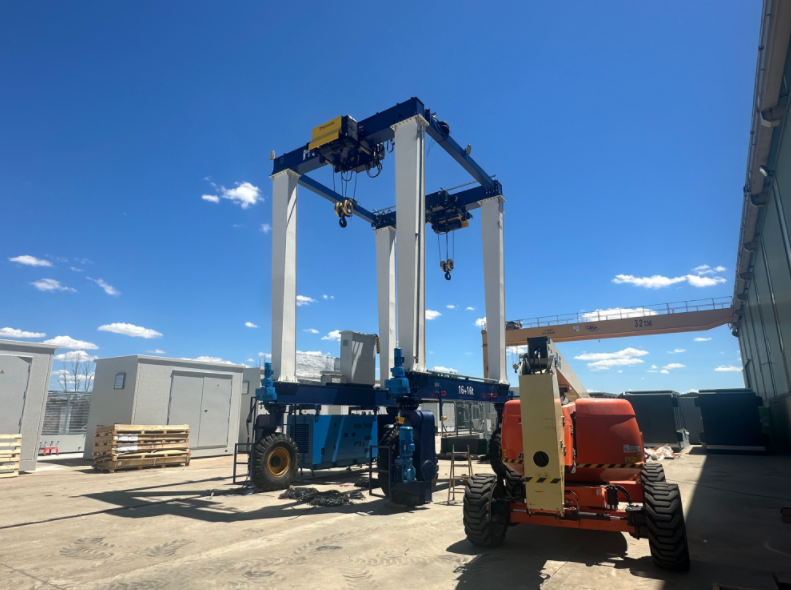
2. Steering System and Yard Adaptability
Mobility is the core advantage of rubber tyred gantry cranes, but not all steering systems offer the same level of flexibility.
Advanced steering configurations allow the crane to adapt to complex working environments where space is limited or workflow changes frequently.
Different steering modes directly influence:
- Turning radius in narrow spaces
- Ability to move sideways or diagonally
- Positioning accuracy during load placement
- Tire wear distribution and long-term maintenance cost
In high-density industrial yards, multi-mode steering (including crab steering or diagonal movement) can significantly improve efficiency by reducing repositioning time. In contrast, basic straight-line travel may require additional handling equipment or repeated adjustments.
If your operation involves frequent layout changes or multi-point lifting zones, steering flexibility becomes a decisive factor—not an optional feature.
3. Structural Strength and Fatigue Resistance
The structural design of an RTG crane determines its long-term durability under dynamic working conditions. Unlike static equipment, RTG cranes are constantly exposed to moving loads, uneven ground conditions, and wind forces.
The main girder and supporting legs must withstand:
- Repeated bending stress from lifting cycles
- Horizontal forces during crane travel
- Uneven load distribution during container or component handling
- External environmental forces such as wind pressure
High-quality structural engineering focuses not only on static strength but also on fatigue resistance. Over time, weak structural design leads to micro-cracks, deformation, and alignment issues that reduce operational safety.
In demanding industries like shipyards or precast concrete production, structural rigidity directly affects positioning accuracy and lifting safety. A stable frame reduces sway, improves operator control, and minimizes long-term maintenance requirements.
4. Travel Drive System and Tire Performance
Because the entire crane relies on rubber tires for movement, the travel system is one of the most critical and often underestimated components.
Poorly selected tire systems can lead to uneven wear, reduced traction, and unstable operation—especially under heavy loads.
Key considerations include:
- Tire material durability under heavy pressure
- Ground adaptability (concrete, gravel, or mixed surfaces)
- Load distribution across multiple wheel sets
- Drive motor torque consistency
- Braking performance under full load conditions
In real industrial environments, cranes rarely operate on perfectly flat surfaces. Any unevenness in the ground increases stress on tires and travel motors. Therefore, a well-designed RTG crane should include a balanced wheel load system that ensures stability even under challenging conditions.
A strong travel system reduces downtime and ensures consistent operational flow across the entire yard.
5. Lifting Mechanism Precision and Control Stability
The lifting system is the heart of any gantry crane for sale. However, performance is not only defined by lifting speed or capacity—it is defined by control precision.
Modern RTG cranes rely on advanced control technologies such as frequency conversion systems to ensure smooth lifting, lowering, and positioning.
Critical factors include:
- Smooth acceleration and deceleration
- Load positioning accuracy
- Anti-sway performance during lifting
- Stability during sudden stops or directional changes
- Synchronization between hoisting and travel motion
Without proper control stability, even experienced operators may struggle with load swing, reducing both safety and efficiency.
For high-value cargo such as precast beams, containers, or large steel structures, precision control directly reduces damage risk and improves workflow speed.
6. Electrical System Reliability and Automation Level
The electrical system defines how intelligent and reliable the crane will be in real operation. A weak electrical system leads to frequent breakdowns, inconsistent performance, and higher maintenance costs.
Modern RTG cranes increasingly integrate automation and smart control features, including:
- PLC control systems
- Remote operation capability
- Fault diagnosis systems
- Energy-saving frequency drives
- Real-time monitoring sensors
These systems not only improve efficiency but also reduce operator fatigue and human error.
In large-scale operations such as ports or industrial logistics centers, automation becomes essential for maintaining consistent workflow and reducing dependency on manual control.
A reliable electrical architecture ensures smooth operation even under harsh environmental conditions such as dust, humidity, or temperature fluctuations.
7. Safety Systems and Environmental Adaptability
Safety is not a single feature—it is a system of multiple protections working together to prevent accidents and equipment failure.
A properly designed RTG crane should include:
- Overload protection systems
- Emergency stop functions
- Wind speed monitoring and anti-storm locking devices
- Anti-collision systems
- Limit switches for all motion directions
- Operator cabin safety features
In outdoor environments, wind load protection is especially important. Without proper anchoring or braking systems, cranes can become unstable under strong wind conditions.
Environmental adaptability also includes:
- Corrosion protection for coastal or humid areas
- Dust resistance for construction zones
- Temperature tolerance for extreme climates
A safe crane is not just compliant with standards—it is designed for real-world unpredictability.
Final Thoughts
Buying a rubber tyred gantry crane is not just a procurement decision—it is a long-term operational strategy. The real performance of an RTG crane is defined by how well its core systems work together under continuous industrial pressure.
While price and capacity are often the first things buyers compare, the seven features above determine whether the crane will deliver stable performance, low maintenance cost, and long service life.
A well-selected RTG crane becomes a productivity asset. A poorly selected one quickly becomes a liability.
Choosing carefully today ensures operational stability for years to come.